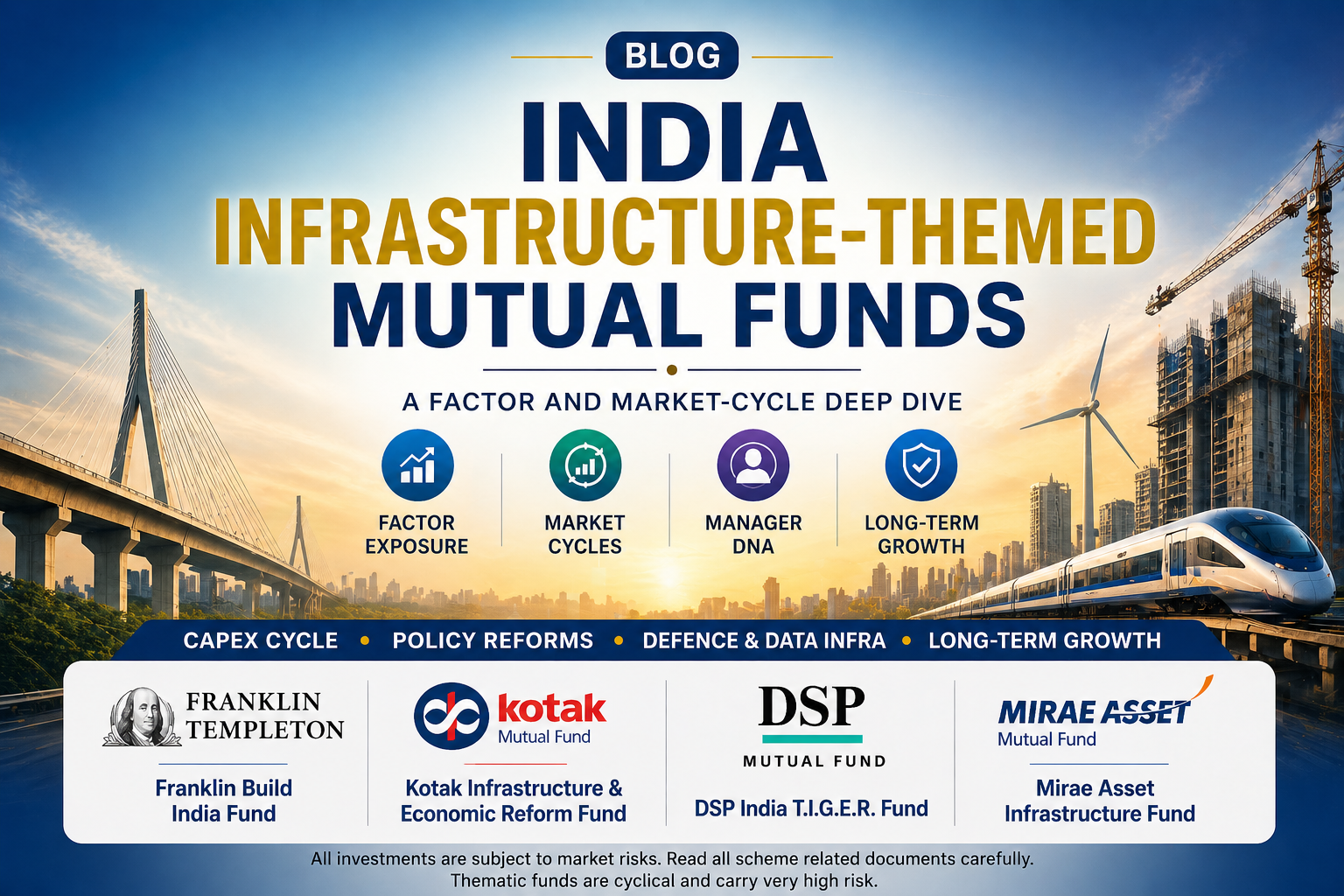
India Infrastructure-Themed Mutual Funds
A factor and market-cycle deep dive
Franklin Build India · Kotak Infra & Eco Reforms · DSP India T.I.G.E.R. · Mirae Asset Infrastructure
1. The lens: factors and cycles, not labels
All four funds wear the same SEBI label – ‘Equity:Thematic – Infrastructure’. That label is almost uselessly broad. What actually drives their returns is:
- Factor exposure – the implicit style tilt the manager runs: value, growth, quality, momentum, and the underlying cyclicality.
- Cycle positioning – which phase of the capex, rates, risk cycle the portfolio is built for. Two infra funds can own the same ten names in different weights and produce very different outcomes across a decade.
- Manager DNA – stated philosophy, tenure, and the behavioural fingerprints visible in the portfolio (position sizing, churn, mid cap vs. mega cap conviction).
This brief drops the flat comparison frame and treats each fund as a separate investment character with its own regime preferences. Think of it as four sports cars: same segment, same engine size, but very different tuning.
Factor mixes at a glance
| Factor exposure | Franklin Build | Kotak Infra & Eco | DSP T.I.G.E.R. | Mirae Infra |
| Value | High (primary tilt) | Medium-High | Medium | Low |
| Growth | Low | Medium | Medium-High | High (primary tilt) |
| Quality | Medium (mega cap PSU) | Medium-High | Medium | High (primary tilt) |
| Momentum | Low | Medium | Medium-High | Medium |
| Cyclicality | High | Medium | Very High | Medium-High |
| Dominant style | Deep value, PSU-tilt | Reform-led blend | Cyclical | Quality growth |
2. Franklin Build India Fund – the value merchant
| Fund name | Franklin Build India Fund |
| Inception | 4 September 2009 – one of the first infra funds launched after the 2008 bust |
| AUM (Apr 2026) | ~₹3,174 Cr |
| NAV (Direct, 20 Apr 2026) | ₹171.69 |
| Current managers | Ajay Argal (lead, ex-HSBC, Barings), Kiran Sebastian, Srikesh Nair |
| Legacy manager | Anand Radhakrishnan ran the fund for ~9 years; style was cyclical-value |
| Portfolio P/E | 19.80 (category 26.90) – cheapest of the four |
| Standard deviation | ~13.8% (Direct) – lowest volatility among peers |
| Sharpe ratio | ~1.04 |
| Alpha (3-yr) | ~3.99 |
| Benchmark | BSE India Infrastructure TRI |
| 3-yr / 5-yr CAGR | ~25.5% / ~23.0% |
2.1 The DNA
Franklin Build India was designed as a vehicle to pick cyclically cheap Indian infrastructure exposure after the 2008 bust. The lineage matters: for most of its life it was run by Anand Radhakrishnan, a manager widely associated with Franklin’s ‘cyclical value’ school of thought. Radhakrishnan himself said in interviews that Franklin’s value style went through a cold stretch between 2018 and 2020 when money chased quality ‘bluechip’ compounders and cyclicals were ignored. That is the regime where Franklin Build India underperformed.
The current team – Ajay Argal, Kiran Sebastian and Srikesh Nair has kept the value DNA intact but tightened position sizing. The fund today still looks like a cyclical value infra book.
2.2 How you spot the value tilt in the portfolio
- P/E 19.80 against a category P/E of 26.90. That is roughly a 25–30% discount to the infra category which is a structural, not tactical gap.
- PSU-heavy top-10: ONGC (6.11%), NTPC (4.72%), SBI (3.59%), REC (3.27%) plus Axis and HDFC Bank on the private side. PSUs are the natural habitat of value-cyclical investors in India.
- Almost no ‘premium’ capital-goods names: No ABB, Siemens, Trent or Titagarh in large weights here. The manager will not pay 60× for a capital-goods bull.
- Banks treated as capex financiers: ~17–18% of the book sits in financials not because this is a BFSI fund, but because the manager believes the capex cycle needs a financier and would rather own REC and SBI at 1–2× book than L&T at 40× earnings.
- Lowest volatility of the four: ~13.8% standard deviation versus ~17–18% for Kotak and ~19–20% for DSP. Value tilt + mega-cap tilt = smoother ride.
2.3 Cycles where Franklin Build India shines
Sweet spot The fund wins when value rotates back into favour, PSUs re-rate, or rates are cut and cheap cyclicals catch a bid. It also outperforms in mid/small cap drawdowns because its book is anchored in mega cap PSUs with low liquidity risk when risk-off hits, its drawdown is materially shallower than Mirae’s or DSP’s. |
Where it lags
- Narrow quality-led rallies: 2018–20 style compounder runs a well-documented cold period for Franklin’s value style.
- Late-cycle momentum blow-offs: When capital-goods names trade at 50–70× earnings and keep going, Franklin deliberately misses the last leg.
- Pure digital infra rallies: If the entire infra alpha comes from Anant Raj / Netweb / E2E, Franklin will sit it out.
2.4 The unique infra expression
Franklin Build India is the most direct PSU-infra + banking-financier play in this set. If a reform package revives PSUs (asset monetisation, dividend payouts, ONGC pricing changes), this fund captures it more cleanly than any peer.
2.5 Specific risks to watch
- Manager stability: The fund has moved through several hands in the last five years. Style drift risk is real.
- PSU re-rating maturity: PSUs re-rated hard between 2022–2025. A lot of the value gap is already closed.
- Benchmark drift: The fund’s heavy financial weight sometimes makes it look like a value fund in infra clothing, which raises category-classification questions for purists.
3. Kotak Infrastructure & Economic Reform Fund – the reform translator
| Fund name | Kotak Infrastructure & Economic Reform Fund |
| Inception | 25 February 2008 |
| AUM (Mar 2026) | ~₹2,339 Cr |
| NAV (Direct, 12 Mar 2026) | ₹74.40 |
| Current manager | Nalin Rasik Bhatt – 15 years equity experience |
| Previous manager | Harish Krishnan ran it from Jan 2015 to Sept 2023 |
| Portfolio P/E | 25.11 (category 28.21) |
| Expense ratio | 0.66% (Direct) |
| Alpha | ~4.55 (post manager change) |
| Standard deviation | ~17.7% |
| Benchmark | BSE India Infrastructure TRI |
| 3-yr / 5-yr CAGR | ~18.8% / ~21.3% |
3.1 The DNA
Kotak’s infra fund has something the others don’t: an explicit ‘economic reform’ clause in its mandate. That single word changes everything. The manager can and does own Bharti Airtel as a telecom reform beneficiary, Shree Cement and UltraTech as housing plays, Solar Industries as defence ancillary and Azad Engineering as precision engineering. All four sit together in one book. This isn’t a hard-hat infra fund; it’s a policy-beneficiary fund.
The manager change in October 2023 from Harish Krishnan to Nalin Rasik Bhatt matters. Krishnan’s style leaned towards quality with a process bias. Bhatt has shifted the book to a cleaner mid cap reform-beneficiary tilt with a longer hold-period mindset. Early post-change alpha has been healthy.
3.2 How the blend shows up
- Telecom at the top: Bharti Airtel is typically ~7% of the book which is the biggest Airtel weight among the four funds. The logic: digital infrastructure, 5G spectrum monetisation and Nxtra Data are reform outcomes.
- Cement double-up: Shree Cement + UltraTech together take ~8–9%. Kotak treats cement as a levered proxy to both government capex and mid-cycle housing.
- Defence-adjacent midcaps: Solar Industries, Azad Engineering, Kalpataru Projects. This is how Kotak expresses the defence + Make-in-India theme without owning HAL/BEL outright.
- Rotating tail: Power Finance Corp, Kajaria Ceramics, InterGlobe Aviation drift in and out. Portfolio turnover is higher than Franklin’s but lower than DSP’s.
- Non-infra sleeves: staples, healthcare, tech: small weights but telling. They exist because the ‘reform’ leg allows them. In the hands of a stricter infra mandate these would be disallowed.
3.3 Cycles where Kotak shines
Sweet spot Kotak wins when a specific policy reform triggers a re-rating: PLI announcements, telecom tariff hikes, GST re-structuring, sharp capex budget. The diversified tail means it captures the reform benefit across several micro themes simultaneously. It also wins when the digital infra theme is dominant. Airtel + Reliance together are ~12% of the book, making it the best data-centre of the four without being labelled a tech fund. |
Where it lags
- Mega cap only rallies: If alpha is all in L&T, NTPC, Reliance, Kotak’s reliance on mid caps is a drag.
- Deep value PSU rotations: Kotak owns fewer PSUs at large weights, so it misses some of the PSU re-rating that Franklin captures fully.
- Sudden manager transition periods: The Oct 23 handover caused portfolio reshuffling that showed up as short-term underperformance.
3.4 The unique infra expression
Kotak is the only fund of the four that treats ‘infra’ as ‘the set of things that benefit when the Indian state reforms or spends’. That definition lets it own Airtel, Shree Cement and Azad Engineering in one coherent thesis. If you’re trying to play the theme of ‘what wins when policy moves’ rather than ‘what wins when a road is built’, Kotak is the cleanest expression.
3.5 Specific risks to watch
- Definition creep: The reform clause is flexible. An investor wanting pure construction/engineering exposure may find this fund has drifted further than they expect.
- Mid cap concentration: Names like Azad Engineering and Kalpataru are liquid enough for ₹2,300cr AUM, but not infinitely.
- Telecom single-stock risk: Airtel at ~7% is a large single A telecom tariff-war restart would hit this fund harder than peers.
4. DSP India T.I.G.E.R. Fund – the cycle veteran
| Fund name | DSP India T.I.G.E.R. Fund – The Infrastructure Growth and Economic Reforms Fund |
| Inception | 11 June 2004 |
| AUM (Apr 2026) | ~₹5,460 Cr (largest of the four) |
| NAV (Direct, 15 Apr 2026) | ₹365.41 (Regular: ₹306.49) |
| Fund manager | Rohit Singhania |
| Stated philosophy | “Buy businesses for less than what they’re worth, cyclicals near troughs, turnarounds with imminent triggers, held long-term.” |
| Portfolio P/E | 31.53 (category 27.31) – premium reflects willingness to pay for late-cycle capex momentum |
| Expense ratio | 0.74% (Direct) – the cheapest of the four |
| Sharpe / Sortino | ~0.29 / ~0.03 (indicative; thematic funds carry low Sortinos) |
| Benchmark | BSE India Infrastructure TRI |
| 3-yr / 5-yr CAGR | ~25.7% / ~24.3% – highest 5-yr CAGR |
4.1 The DNA
Rohit Singhania has been associated with this fund since 2010. He co-leads DSP’s equity desk. That continuity is the biggest structural feature of this fund and it is not replicated in Franklin, Kotak or Mirae.
Singhania’s stated philosophy is a value-cyclical one. But the current portfolio P/E of 31.53, a premium to the category shows the fund is late in the cycle. Functionally, today’s TIGER behaves as GARP (Growth At Reasonable Price) with a cyclical overlay, not as a deep-value fund.
4.2 How the cycle positioning shows up
- Broad ‘infra’ definition: Apollo Hospitals (health infrastructure), MCX (market infrastructure), Amber Enterprises (consumer-capex proxy), Rainbow Children (social infra), Kirloskar Oil Engines (industrial). This is the loosest reading of infrastructure in the peer set
- Capital-goods heavy: Solar Industries, Kirloskar, Amber, Power Grid, Coal India, NTPC cluster together to make up ~30–35% of the book.
- Willingness to pay up: P/E 31.53 vs category 27.31. This is the highest premium of the four and it is not by accident.
- Lowest expense: Over a 10-year hold, that’s ~100 basis points of advantage versus Franklin/Kotak/Mirae. In a thematic fund that is a meaningful edge.
- Mid cap willingness: Kirloskar, Amber, MCX, Rainbow, Solar Industries are mid The fund uses its size to own them at meaningful weights without liquidity stress.
4.3 Cycles where DSP TIGER shines
Sweet spot TIGER is built to win the mid-to-late phase of a capex cycle when industrial production is peaking, order books are fat, margins are expanding and capital-goods names are getting momentum bids. It also benefits from broad definitions of infra becoming fashionable, e.g hospitals and data centres being classified as infrastructure. |
Where it lags
- Sharp risk-off / EM outflow events: Mid caps plus elevated P/E = deeper drawdown than Franklin when foreign selling hits.
- Rate hike shocks: Long duration capex bets lose value when bond yields spike. 2022 h3 was a reminder.
- Value rotations: In a pure PSU re-rating rally, Franklin can outrun TIGER because TIGER has already moved to higher-quality / higher-P/E names.
4.4 The unique infra expression
TIGER is the only fund in this set that has weathered a full capex down-cycle (2011–2019) under a continuous manager. That historical scarring is visible in how it constructs risk: never more than ~5%, broad sector spread, preference for companies with balance sheet room. It is the most ‘capex-cycle literate’ fund here.
4.5 Specific risks to watch
- Valuation risk: P/E 31.53 means the fund is vulnerable to multiple compression if earnings disappoint.
- Style drift across a long tenure: Rohit’s stated philosophy is value, but the portfolio reads GARP. Not wrong but investors should understand today’s fund is not the 2012 fund.
- Breadth risk: Broad ‘infra’ definition means an investor wanting pure construction will get less of that than they might expect.
5. Mirae Asset Infrastructure Fund – the quality-growth newcomer
| Fund name | Mirae Asset Infrastructure Fund |
| Inception | Late 2025 NFO – the youngest fund in this set |
| AUM (Apr 2026) | ~₹375 Cr |
| NAV (Direct, 16 Apr 2026) | ₹10.44 |
| Fund manager | Bharti Sawant (18+ years of experience with Mirae AMC) |
| Stated philosophy | Differentiated stock/sector positioning, long-term alpha via private capex, PLI, import substitution and digital infra |
| Portfolio P/E | 27.03 (category 27.31) – in line with category |
| Benchmark | BSE India Infrastructure TRI |
| Track record | Short: has not yet lived through a full drawdown cycle |
5.1 The DNA
This is the only brand new fund in the peer set with an NAV still close to ₹10 par. That means two things. First, a clean sheet book the manager could design for the current cycle (not a legacy portfolio inherited through style changes). Second, no drawdown history. An investor is effectively buying the manager’s philosophy, not their track record.
Mirae’s house style is well-known: quality first, ROCE screens, secular growth bias, moderate concentration. That style fingerprint is already visible in the initial portfolio with high Aerospace & Defence weight, Adani Ports, L&T, NTPC and a deliberate absence of the cheapest PSUs.
5.2 How the quality-growth style shows up
- Large single-name concentration: L&T at 10.23% is the highest single-stock bet among the four funds. Quality conviction, not diversification for its own
- 91% in Aerospace & Defence: Far above any peer. Defence has been a quality-growth theme in 2024–26 because order books extend into the 2030s and return ratios have structurally improved.
- Infrastructure Developers & Operators at 26.71%: Translates to Adani Ports, Adani Power, L&T: cash generating infra operators, not EPC contractors.
- Transport + logistics heavy: Adani Ports + InterGlobe Aviation + Transport Service at ~20% of the book. The thesis is structural rise in Indian logistics intensity.
- Portfolio P/E 27.03 in line with category: Quality growth doesn’t mean expensive at any price. The manager is paying category multiples, not a premium.
5.3 Cycles where Mirae Infrastructure shines
Sweet spot Mirae is built to win in quality led narrow rallies and structural-theme bursts: the sort of regime that rewarded HDFC Bank. In the infra specific context, that translates to defence super cycles, data-centre / digital infra dominance and best in class operator re-rating. Because the book is concentrated and quality-tilted, it should outperform peers when the market narrows around a small set of structural winners. |
Where it lags
- Deep value rotations: The fund owns few cheap PSUs. In a PSU-led re-rating it will underperform Franklin.
- Broad mean-reversion rallies: If everything cheap rises together, concentrated quality books are laggards.
- First real drawdown: Because the fund hasn’t experienced a full correction, it is an unknown quantity under stress. Its large L&T position would magnify a stock-specific shock.
5.4 The unique infra expression
Mirae Infrastructure is the only fund here that makes defence a first-class citizen. It is therefore the best single-fund expression of the ‘Atmanirbhar Bharat + defence indigenisation’ narrative through 2030. If defence is the single theme an investor cares about, this fund is the least diluted way to own it inside an infra mandate.
5.5 Specific risks to watch
- Single-name L&T risk: 23% in one stock is a concentrated bet. Elegantly reasoned but if L&T has a bad quarter the whole fund feels it.
- NFO premium / discovery risk: An NFO launched at cycle highs (late 2025) will often revisit ₹10 par before it compounds and that’s already partially visible.
- Defence order lumpiness: 9% in defence means quarterly results can be noisy. A 6-month delay in a single DAC clearance moves HAL, BEL and Bharat Dynamics at once.
- Category evolution: The fund will have to prove its differentiation versus Mirae’s sister funds. Style purity matters.
6. The cycle compass
| Market regime | Franklin Build India | Kotak Infra & Eco | DSP T.I.G.E.R. | Mirae Infrastructure |
| Deep value rotation (PSU re-rating, cheap mean-reverts) | Best | Good | Good | Poor |
| Early-cycle capex recovery (rates cutting, order books waking) | Best | Good | Good | Good |
| Mid-cycle capex boom (margins peaking, capital-goods momentum) | Good | Good | Best | Good |
| Late-cycle / euphoria (expensive breadth, momentum dominant) | Poor | OK | Good | OK |
| Quality-led narrow rally (2018–20 style) | Poor | OK | OK | Best |
| Policy-reform burst (PLI, GST, telecom tariff, capex budget) | Good | Best | Good | Good |
| Defence super-cycle (order-book led) | OK | Good | Good | Best |
| Data-centre / digital-infra theme dominance | Good | Best | OK | Good |
| Risk-off / EM outflow (foreign selling) | Good | OK | Poor | OK |
| Rate-hike shock / bond-yield spike | Good | OK | Poor | OK |
| Mid/small cap drawdown (liquidity unwind) | Best | Poor | OK | Poor |
7. Defence, data centres and infrastructure – how each fund plays them
7.1 Defence
The Indian defence thesis is structural through 2030: indigenous procurement floor at ~75% of capex, order books extending 8–10 years and return ratios that have moved from mid teens to 20%+. But it has always been cyclical within the structural trend.
- Mirae Infrastructure – direct exposure (17.9%), the cleanest expression. Expect HAL, BEL, Bharat Dynamics, Data Patterns, Solar Industries, Azad Engineering to rotate through the top
- DSP T.I.G.E.R. – moderate via Solar Industries (~2.3%), L&T (~4.8%) and rotating HAL/BEL positions.
- Kotak Infra & Eco – defence-adjacent rather than pure: Solar Industries (propellants), Azad Engineering (precision aerospace components for GE/Boeing/Raytheon/HAL), L&T (submarines, missiles).
- Franklin Build India – weakest expression, mostly via L&T (~8.7%). If defence is the primary thesis, this fund under-delivers on that specifically.
7.2 Data centres
India’s operational DC capacity is projected to roughly double to ~2 GW by 2026 and grow at ~26% CAGR to the end of the decade. Budget 2026 added a 21 year tax holiday for foreign cloud firms operating out of Indian DCs, re-rating listed plays overnight.
- Kotak Infra & Eco – best expression. Airtel (~7%) + Reliance (~5%) captures both Nxtra Data and the Digital Connexion JV in one book.
- Franklin Build India – close second. Reliance 5.85% + Airtel 4.65% + NTPC 4.72% gives it the hyperscale sponsor and power supply stacks.
- Mirae Infrastructure – The 14.93% in electrical capital goods captures the picks-and-shovels layer of the DC build-out.
- DSP T.I.G.E.R. – least geared. Airtel sits at only ~2.4%, no major DC small Expect the least beta to a pure DC re-rating.
7.3 Infrastructure: the core
The word ‘infra’ splits into four stacks. Each fund owns a different mix.
- Traditional hard infra (EPC, roads, ports, power, airports): L&T, NTPC, Power Grid, Adani Ports, InterGlobe Aviation, Kalpataru.
- Capex-cycle capital goods (industrial engineering, specialty chemicals, durables): Kirloskar, Amber, Solar Industries, Azad Engineering, Cummins, ABB.
- Infra financiers (banks + NBFCs as capex lenders): SBI, Axis, HDFC Bank, REC, Power Finance.
- Digital / social infra (telecom, hospitals, exchanges): Airtel, Reliance, Apollo Hospitals, Rainbow Children, MCX.
8. Pulling it together – four characters, not four clones
- Franklin Build India: The value merchant. Cheapest P/E, PSU-heavy, lowest volatility, best in value rotations and early-cycle / mid-cap-drawdown regimes. Weakest on defence, weakest in quality rallies.
- Kotak Infra & Eco: The reform translator. Broad definition of infra, best DC proxy, defence-adjacent via midcaps, best in policy-reform bursts. Weakest in pure mega cap PSU rotations.
- DSP T.I.G.E.R.: The cycle veteran. GARP with cyclical overlay, highest P/E but lowest expense, longest-tenured manager, best in mid-to-late capex cycles. Weakest in sharp risk-off and rate shocks.
- Mirae Infrastructure: The quality growth newcomer. Highest defence weight, most concentrated book, best in quality-led and structural-theme regimes. Weakest in value rotations, untested in a real drawdown.
Overlap is surprisingly low. L&T, NTPC, Reliance and Airtel are the only names that appear in multiple top-10s. So a two-fund combination from this set is not double counting, it is genuinely diversified.
Pairing suggestions
- Maximum style diversification: Franklin (deep value) + Mirae (quality-growth).
- Reform + cycle alpha: Kotak (reform) + DSP (cycle).
- Defence forward with a value hedge: Mirae + Franklin.
- Single-fund simplicity for the next 3 years if the capex cycle broadens: DSP or Kotak – they carry the broadest definition of infra.
9. Category-level risks and caveats
- All four are thematic sectoral funds and carry Very High risk by SEBI’s classification. Drawdowns of 30–45% in a deep capex-cycle pause are within historical range.
- Portfolio snapshots change every month. Every number in this brief reflects the latest available month end factsheet in Mar–Apr 2026. Cross check against the fund’s factsheet before acting.
- Past returns are not predictive. The 2021–25 infra bull market has been atypical in breadth and duration; mean-reversion risk grows each year.
- Manager transitions (Kotak in 2023, possibly more to come at Franklin) can cause meaningful short-term tracking error versus the fund’s stated style.
- Regulatory risk on specific themes for instance, a retrospective tax on data-centre incentives or a defence procurement policy shift would hit Mirae and Kotak more than Franklin.
10. Sources and further reading
- Franklin Build India Fund – Tickertape
- Franklin Build India Fund – Value Research
- Franklin Build India Fund – Groww
- Anand Radhakrishnan interview on Franklin’s value style through 2018–20 (Value Research)
- Kotak Infra & Eco Reform Fund – Tickertape
- Kotak Infrastructure & Economic Reform Fund – Kotak MF factsheet
- Rohit Singhania investment framework (DSP, PDF)
- DSP India T.I.G.E.R. Fund – DSP website
- DSP India T.I.G.E.R. Fund – Tickertape
- Mirae Asset Infrastructure Fund – Mirae MF factsheet
- Mirae Asset Infrastructure Fund NFO launch context (Business Today)
- Defence stocks – MF buying/selling March 2026 (Business Today)
- Budget 2026 data-centre tax holiday (Upstox)
- Can India be at the cusp of a new capex cycle? – Axis MF (PDF)